
Data for Policy 2026: "Governance of/with AI: Implications for Data, Infrastructure, and Tech Sovereignty"

Barcelona, September 8-10, 2026
On 10 September 2026, Mireia Paulo, Head of Management at the Centre for EU–Asia Connectivity (CEAC), presented her research at Data for Policy 2026 at Universitat Pompeu Fabra in Barcelona, Spain.
Held from 8 to 10 September under the theme Governance of/with AI: Implications for Data, Infrastructure, and Tech Sovereignty, the tenth edition of the international conference brought together approximately 200 researchers, policymakers and practitioners from 44 countries. Its programme comprised 123 research contributions, five keynote sessions, four plenary sessions and two Digital Statecraft debates, making it an important international forum for interdisciplinary discussion of AI, data governance, and public policy.
Paulo’s paper was selected for the Digital Statecraft special track, convened by the Digital Statecraft Academy. She spoke during DS Special Track — Session C4: Digital Infrastructure, chaired by Tim Gordon, Co-Founder of the Digital Statecraft Academy.
Her presentation, “From Data Securitisation to AI Governance: China’s Emerging Model of Digital Statecraft,” examined how the securitisation of digital data has shaped China’s AI governance between 2012 and 2026. The research argues that China’s emerging AI governance is not an entirely separate regulatory field, but an extension of a broader securitised data regime in which data, digital infrastructure and AI systems are treated as strategic assets connected to national security, digital economic growth, and technological sovereignty. The paper builds on her earlier research on EU–China data governance and advances her current work on AI governance and securitisation, implications to the EU/Germany.



Three-day programme overview
Day One – 8 September:
The conference opened with a keynote by Alberto Gago Fernández, Director of the Spanish Agency for the Supervision of Artificial Intelligence, followed by the plenary Strategies for a Public AI: Cooperation for Sovereignty, Governance and Resilience.
Parallel sessions examined participatory AI and public perceptions, technologies for AI governance, adaptive institutions, accountability and transparency, AI-driven law, international Digital Statecraft case studies, data spaces, generative and agentic AI, the economies and funding of AI, and the relationship between the state, citizenship and digital technologies.
A further plenary consulted participants on the Digital Statecraft Manifesto 2026.
The day concluded with visits to Ca l’Alier, Barcelona’s urban innovation centre housing BIT Habitat, the Cisco Innovation Center and the Giga Technology Centre, and the Barcelona Supercomputing Center, including its MareNostrum supercomputing facilities.
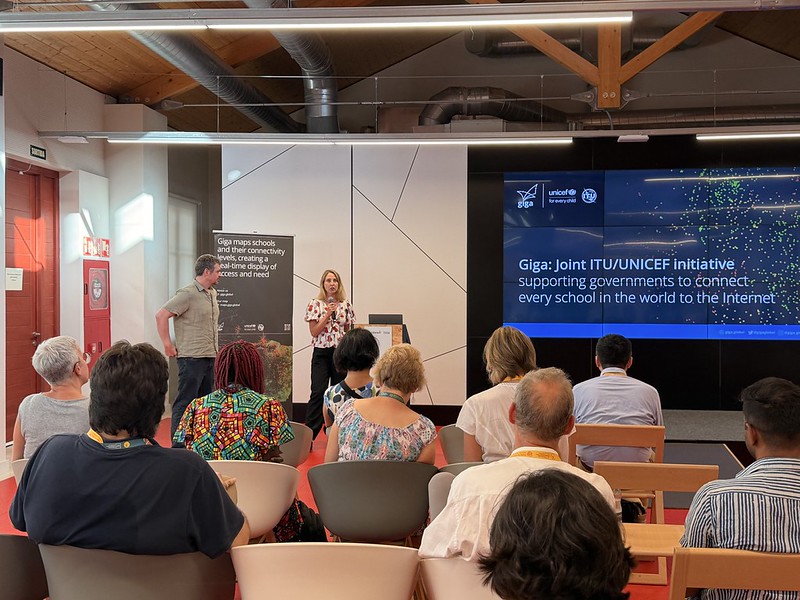
- Day Two – 9 September: Discussions began with Stefano Iacus’s keynote on transparency and sovereignty under the Digital Services Act, Digital Markets Act and AI Act, followed by the plenary Impact of AI on the Public Commons. The day’s parallel sessions covered governmental and public sovereignty; accountable AI in public policy, healthcare and legal services; digital infrastructure; data colonialism; governance with AI; governance at the margins; regulatory compliance; data cooperatives; geopolitics; content moderation; and digital and infrastructure sovereignty. The programme also included sessions on AI compliance and governability within the Digital Statecraft track. The day concluded with keynotes on transforming citizens’ stories into policy insights and improving children’s connectivity, as well as a Digital Statecraft debate on whether the state remains the primary institutional form of governance in the algorithmic age.
Day Three – 10 September: The final day opened with the plenary Responsible AI: From Principles to Practice, followed by a keynote on European technological resilience and sovereignty and a debate on whether governance can—or should—operate at algorithmic speed. Parallel sessions addressed responsible AI in policing and criminal justice, high-risk AI systems, legitimacy in algorithmic mediation, urban governance, journalism in the AI era, evidence from Latin America, authority and accountability, urban AI, official statistics, trust in data sharing, and misinformation and democracy.